
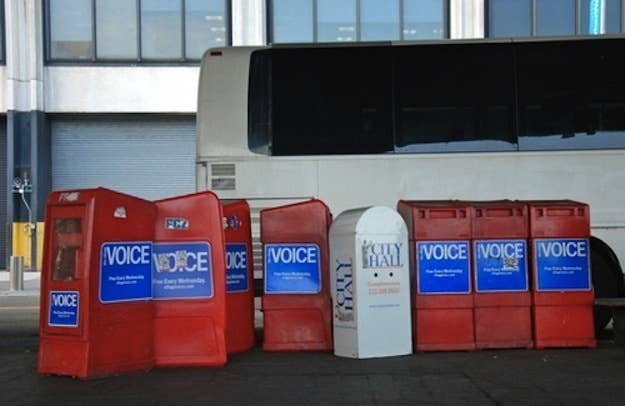
Alt-weeklies are always dying. But the news Friday that four editorial staffers were laid off or had their hours cut to part-time at The Village Voice — two features writers, a news blogger and a listings editor — makes the sad fact of that paper’s eventual demise, evident for years, more immediate. The paper now has one news blogger, two features writers, a music editor, a few people working on listings and one critic, aided by a couple contributors, writing about food.
The layoffs at the Voice weren’t the only ones: papers across the Village Voice Media company, which owns more or less every notable alternative weekly nowadays, experienced layoffs, I’ve learned, including those in Minneapolis, Phoenix, Los Angeles, San Francisco, Dallas, and Broward-Palm Beach. The Voice itself is planning to move out of its iconic East Village office space in the near future, as I and other staff members found out last year. There have been many ends of an era for a paper that always prided itself at being on the vanguard, but this one seems permanent and final: “I can’t imagine how much leaner they can get,” said a friend of mine who was recently let go from the Dallas Observer.
At the Voice, people found out the hard way. They tried to log onto their accounts and couldn’t. This happened to blogger Victoria Bekiempis and to reporter Steven Thrasher, who still hadn’t spoken with his boss when I called him at 5:30 Friday evening; he learned the extent of the news through texts and tweets, he said. It was a harsh way to go, but fit what the Voice has become.
The Voice suffered from the same ailments that afflict print media organizations everywhere, but it proved less adept than most at adapting to the changing media. Or maybe it’s more accurate to say that adapted to the Internet in the entirely wrong way, figuring out only the web’s seamiest edge. In the past year, Village Voice Media has been consumed by controversy, and been the target of a national campaign, around its ownership of Backpage.com, a site that basically digitizes the sex ads the Voice has always made money off of. While the back page print ads were always an accepted part of the paper’s identity, the online equivalent developed a more straightforward reputation as a seedy haven for child sex traffickers. It’s been considered a ticking time bomb for a while now, and lawmakers in New York and elsewhere seem bent on legislating it out of business. (A spokesperson for Village Voice Media didn’t immediately answer a query as to whether or not Backpage in any more trouble than usual. LIz McDougall, VVM's general counsel who handles Backpage issues, said in an email that "No new or proposed legislation is impacting Backpage.com" and pointed me to a federal court decision in Washington state that found a law targeted at Backpage to be unconstitutional).
The troubles at the parent company and with Backpage have sapped the paper of money, but they’ve also sapped staffers of morale and given the place a depressing mien.
My first job was at the Voice, where I started as an intern the summer before my junior year of college. It was experiencing its final burst of relevance then, as it had hired buzzy writers like Foster Kamer and Jen Doll to work alongside some of the heavyweights who connected the paper all the way back to its 1970s glory days— J. Hoberman, Wayne Barrett, and Tom Robbins. They started paying me later that year as the weekend editor of the news blog, and I was hired full time that summer.
You could tell at first glance there was something wrong at the paper, but there’s something wrong at every paper. Anyway, it was my first job, and I didn’t know what a healthy office looked like. There were always whispers of possible layoffs and no one ever seemed secure. No one trusted the management. The staff assumed that Village Voice Media Executive Editor Mike Lacey and his team were interlopers bent on squeezing the last drop of juice out of the paper before leaving it to die. (They took the name of the New York weekly when their chain, New Times, bought it in 2005.) We didn’t think they cared one bit about what happened at their flagship paper, and we had a sinking feeling that they’d be willing to hurt the Voice instead of shuttering or selling other papers in the chain.
That fear was confirmed last October, when I showed up at work and for once, all the writers were there, huddled around one cubicle (a lot of people no longer bothered to come in every day, even at that point). Four members of the editorial staff had been laid off, including the talented City Hall columnist Harry Siegel (now we had no one covering politics) and Ward Harkavy, the deputy editor who had been a Voice stalwart for years (now we had no one apart from the editor-in-chief looking at our stories).
We had actually been lucky. Other papers in the chain, like O.C. Weekly or Minneapolis CityPages, were down to a couple features writers and a blogger each. And we still thought there was no way that they would gut the Voice totally — it was too much of an institution, too central to New York.
As it so happens, we were wrong. The Voice, dying for so long, seems finally on the verge of actual collapse. (Voice editor-in-chief Tony Ortega declined to comment on how he’ll continue to fill the paper and site with content).
The new crew shouldn’t take all the blame. The slide began in earnest with a series of bad choices the mid-‘90s, when the decision was made to give away the paper for free without a clear idea of what changes the Internet would bring.
By the early 2000s, the paper’s condition was dire enough that the entrance of Lacey, his business partner Jim Larkin, and their team was actually viewed with anticipation. In a New York magazine story from 2005, Mark Jacobson, a former Voice writer, wrote that the “The great takeover of 2005 inspired no rampart-mounting” like earlier takeovers such as Rupert Murdoch’s 1977 purchase, when, famously, the Voice staff occupied the offices and didn’t allow the new editor in.
But, Jacobson wrote, “This was too bad, since Michael Lacey, Jim Larkin, and their New Times papers offer much potential fodder for traditionalist Voice fear and loathing.”
The Village Voice Media men — and they’re pretty much all men — have a reputation as hard-living libertarian types. I've heard the words "frat boys" and "assholes" used to describe them, and have maybe used those myself. Staffers used to gossip about their alleged bar fights during business trips, and there was much snickering when Lacey installed an ex-girlfriend as the editor-in-chief of LA Weekly.
They’ve had their moments of Voice-esque brilliance, like when Larkin and Lacey were arrested for revealing grand jury information in a story about how the Phoenix New Times was being targeted by an Arizona grand jury.
But for the most part, they’re not Voice people. And it’s hard to explain the importance of being a Voice person if you’re not one. The Voice, as marginalized and irrelevant as it has become, really was the voice of the city and of a certain kind of New Yorker. It was insouciant and jubilant, with sharply reported city politics pieces sitting next to art house movie reviews and sex ads. The afterglow of that leaves an impression on those of us who worked there, even if you’re like me and were born well after the Voice’s heyday.
Jacobson writes it like this:
Thanks for the phrase go to Cynthia Cotts, who used to write the Voice “Press Clips” column (she reported on New Times’ failed 2000 attempt to buy the Voice, calling it a “hostile takeover”). “The Village Voice,” she said. “It is the wound that never heals.”
This I take to mean that once you are a Voice Person—no matter how many years go by or the number of jobs you do—you will always be a Voice Person.
But I think the best description of what the Voice was supposed to be about, back when it was a pet project of some beatniks in a two-bedroom apartment in Greenwich Village, comes from Norman Mailer himself in his very first column for the paper in 1955:
“At any rate, dear reader, we begin a collaboration, which may go on for three weeks, three months, or, Lord forbid, for three-and-thirty years. I have only one prayer —that I weary of you before you tire of me. And therefore, so soon as I learn to write columnese in a quarter of an hour instead of the unprofitable fifty-two minutes this has taken, we will all know better if our trifling business is going to continue. If it does, there is one chance in a hundred — make it a hundred thousand — that I will become a habitual assassin-and-lover columnist who will have something superficial or vicious or inaccurate to say about many of the things under the sun, and who knows but what some of the night.”
Updated to include comment from Liz McDougall.