
This piece originally appeared on Cyborgology.
Recently mentions of a new “real-time social feed” called App.net have been creeping into my Twitter feed. Just as the quietly simmering Diaspora and the running joke that is Google+ were geared to seize on collective Facebook malaise, it seems App.net is trying to seize on some degree of unrest among Twitter users before taking on Facebook as well. In this case, App.net promises that “users and developers [will] come first, not advertisers.” In an era of “if it’s free, you’re the product” — remember that the much love/hated Facebook promise that “[is] free and always will be”— App.net proposes to offer a Twitter-like social feed (and eventually a “powerful ecosystem based on 3rd-party developer built ‘apps’”) on a paid membership basis instead.
At first, this struck me as a reasonable enough idea: I’m pretty much always willing to pay for the upgraded version of an app or service rather than be bombarded with ads (though in this case, my particular Twitter client and the AdBlock Plus add-on have already solved the problems of “promoted tweets” and Facebook ads). Yet it turns out App.net will not be an advertising- or promotion-free environment just because App.net itself won’t derive revenue from ads; the company has no plans to “restrict commercial messages from appearing on the service,” and instead suggests that users — who have “complete control over the kinds of messages they see” — simply unfollow accounts that post annoying messages. App.net describes this as “the beauty of a follow model,” but I’m skeptical. For instance, the “follow model” does not seem to have stopped spammers on Twitter, and unlike App.net’s founder Dalton Caldwell, I’m not convinced a $50 paywall will keep spammers away. Still, I liked the idea of my information (“my information”) not being sold to marketers, so I kept reading.
When I got to the $50 price point (pre-paid) of joining App.net for a year, however, I started to see the service a bit differently. I realize that any app or service charging at least $4.17 per month (and there are a lot of them) also costs at least $50 per year, but that actually isn’t the point here — the point is the stratifying effect of asking for $50 upfront instead of asking for $4.17 every month. Was this stratifying effect intentional, or an oversight? Some clicking around indicates that it’s probably intentional, with one interview article stating that the $50 pre-paid membership cost is “really more of a ‘are you serious’ fee.” Caldwell believes that “Twitter could have been something more, and perhaps better, than what it has become,” and so has set out to build a service not for the masses, “but for the hacker masses.”
The “hacker masses” are, of course, a much less diverse crowd than are the ‘regular’ masses. Recall that Twitter’s original ‘early adopter’ user base in 2007 was the so-called digerati, who are largely affluent white men with connections to the tech industry; recall as well that in 2012, “it’s a black Twitterverse; white people only live in it.” “How Black People Use Twitter” got a lot of attention on Slate two years ago (despite describing how only some Black users use Twitter), and let’s not forget how many Arab-region users joined Twitter during last year’s Arab Spring. Meanwhile, those “keen and savvy” early adopters now complain because services like Twitter and Facebook “haven’t developed with us” [emphasis in original], and Caldwell himself sees K-Mart ads in his feed as just another sign of Twitter’s appalling degradation and debasement. OMG it’s the end of the world: K-mart shoppers and people of color found Twitter.
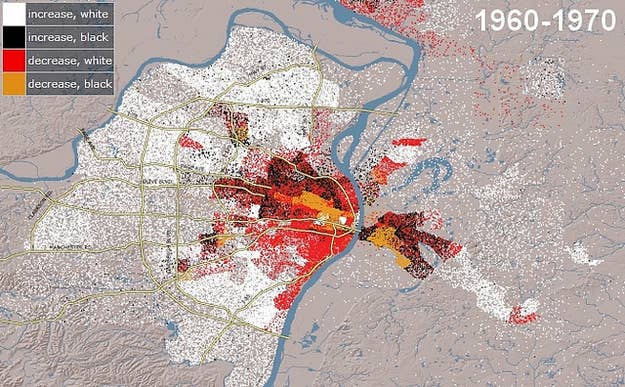
I’m now wondering if App.net doesn’t mark the beginning of “white flight” from Twitter and Facebook, just as danah boyd has argued that Facebook was the “white flight” from Myspace before that. Both sites have certainly grown beyond their early-adopter user bases: Twitter had 500 million users as of February 2012, and with 955 million users [pdf] as of June 2012, “everyone” is supposedly on Facebook; your mom is on Facebook (hell, my mom’s on Twitter, too), and there’s even a growing chance your grandma is on Facebook (though I admit that mine isn’t). Facebook has become so quotidian — some would even say pedestrian — that as Laura Portwood-Stacer argues, not being on Facebook has become the new, cool status marker (esp. for affluent white tech people). Given all the cultural and economic capital there is to be gained from participating in social media, however, it wouldn’t be surprising if some people who are "too cool" for Facebook and Twitter are not yet too cool for social networking sites in general, especially sites you need $50, $100, or $1000 upfront to join. In fact, App.net is betting there are at least 10,000 people willing to pay $50, to start.
Before I return to the issue of App.net’s $50 entry-level membership fee and its stratifying effects, I want to acknowledge that, although race and class are complexly interrelated and intersecting axes of oppression, they are not the same thing. One of my pet peeves is when people treat race and class as if they’re interchangeable; for instance, when the Fordham Institute talks about the 25 “fastest-gentrifying neighborhoods” in America, the author is really referencing US Census data for the 25 zip codes with the largest increases in percentages of white residents. As a transitive verb, “gentrified” means “renovated and improved so that it conforms to middle-class taste.” Fordham is therefore using ‘percentage of white residents" as a proxy for ‘percentage of middle-class residents’, which inherently perpetuates the stereotypes that white people are middle-class and people of color are poor. Because of this, I find Fordham’s proxy (and others like it) to be ideologically problematic, even if an influx of white people does seem to correlate with fewer bodegas and more cupcake merchants. Plus, when we remember that the adjective meaning of “gentrified” is “more refined or dignified,” equating ‘more white’ with ‘more gentrified’ is just offensive.
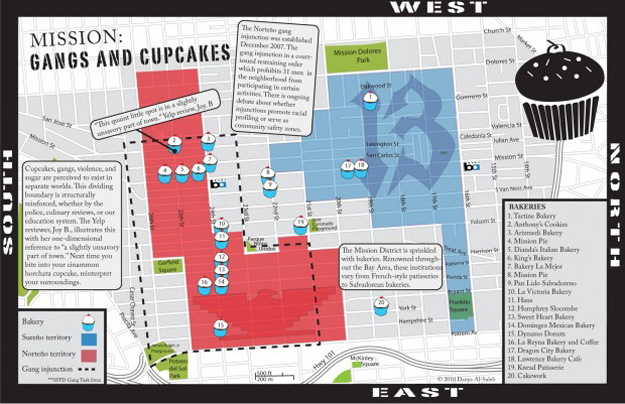
Anyway, the point here is that when I talk about a possible link between App.net’s class-stratifying $50 backing fee and the beginning of ‘white flight’ from Facebook, I’m not suggesting a 1:1 correlation between whiteness and affluence, nor am I suggesting that race and class are interchangeable. I am, however, referencing the fondness that some affluent white people have for buying goods and services that help them decrease the visibility of poor people and people of color around them.
If the ‘white flight’ from Myspace to Facebook was like the post-war migration of white people from urban areas to tract houses in the suburbs, App.net could represent the digital equivalent of white people moving from suburban tract houses to gated communities or urban loft conversions. It contains elements of both white flight (affluent white people distancing themselves from the more diverse user bases of Facebook and Twitter) and gentrification (affluent white people creating a site that conforms to their tastes and has a higher cost of entry), and to me, these things make App.net seem a lot less appealing: I’m happy to escape “being the product,” but joining a digital country club holds little appeal.
In addition to market appeal based subtly and not-so-subtly on fleeing from the ‘Others,’ and on utopian rhetoric about fleeing from evil corporations (“Open. Free. Joy. Wonder. Peace. Perfection”), App.net taps into the same neoliberal self-interest on which all privatization ventures depend. Much of the enthusiasm I’ve seen in my own Twitter feed has been from people who are angry about being “the product,” but if there’s a harm to being the product (such that would motivate those who can pay to join a different social networking site to do so), shouldn’t we maybe address that harm directly and collectively?
Buying our way out of personal exposure to a problem doesn’t address the problem itself, and it still leaves those who can’t afford to buy their way out exposed. Buying bottled water might get your kid away from (say) trichloroethylene, but it won’t stop your neighborhood from becoming a leukemia cluster; ‘voting with your dollar’ for App.net instead of Facebook or Twitter might subject you to fewer ads and less data-mining, but it’s not going to affect how Facebook, Google, or anyone else operates, nor will it slow the push toward targeted marketing in general.
One might be tempted to argue that ‘early adopters’ in general tend to be disproportionately white, male, and economically privileged, and that perhaps App.net would — like both Myspace and Facebook — become more diverse over time (especially if the pricepoint of using their service came down). I tend to think not, given that the ‘for us, by us’ here is software developers. Or perhaps we shouldn’t expect App.net to have any kind of positive impact on the world; maybe they’re just out to make some money by offering a service for which there seems to be a market. But for those of us who see the appeal or value of a user-centered social networking site, I wonder if this is the best way to go about building one.
Whitney Erin Boesel is a graduate student in Sociology at the University of California, Santa Cruz, and a regular contributor for Cyborgology.