
This piece was originally published in April of this year, in response to a change in the Google Drive terms of service. Instagram's TOS, which many were then holding up as as a model for others, has since been changed, and people are upset — again.
Here's the thing: It was never as good as it seemed.

Have you ever actually read the terms of service on a site like Google or Facebook? Better question. Have you read a lot of them? If you have, you'll recognize a pattern: after a ream or two worth of throat clearing, most terms of service get around to the bad part:
When you upload or otherwise submit content to our Services, you give us a worldwide license to use, host, store, reproduce, modify, create derivative works, communicate, publish, publicly perform, publicly display and distribute such content.
This, for most people, is the only section that matters. It's the part where every company you interact with online — Facebook, Pinterest, Microsoft, and in the above case Google — seems to be explaining to you, right to your dumb face, that when you upload your content you're giving it away. Despite being the most clearly written passage in the TOS, this is the one that makes you feel like you're getting scammed. This is the one that makes you feel sick about the internet.
This claim, that users still "own" their content but that websites have a nearly unlimited license to use it, has become so ubiquitous that it's practically boilerplate. It's the new normal for content ownership, and it's phenomenally bizarre. Every time you upload a photo to Facebook or even Google Drive, they become your licensees and, in a very specific way, you their licenser. To post a picture of your birthday party on a website is to enter into a complex legal relationship, as if you're leasing someone your home or selling them your labor. The only difference is that you never sign your name, the stakes feel lower and the transaction takes a fraction of a second.
This is the cold, confusing, largely invisible relationship that defines the internet as we know it today.

Google's terms of service sound grabby because they are: the terms of service for Google Drive (and pretty much every Google service) give Google the right to do almost anything with your uploaded content. This isn't because Google has a bunch of really cool ideas for "publicly performing" your photos. It's because copyright law was written before there was a such thing as computers.
"Copyright law itself is really strange," says Greg Lastowka, co-director of the Rutgers Institute for Information Policy & Law. These companies, he says, are only doing "what copyright law forces them to do."
Say you draw a picture. You literally own the paper and the ink that you used to draw it, but the thing you have a copyright for is intangible: it's the pattern, the shapes, the design. If someone comes along a steals your drawing, they're stealing your property. If someone takes a photo of your drawing, they're violating your copyright. "When you say you own a photo," says Lastowka, "you really mean 'I have the exclusive right to reproduce my photo.'"
In a world where sharing a photo is strictly a matter of getting another copy made and mailing it, or getting it published, copyrights are pretty easy to keep track of and these laws hold up pretty well. Sending a physical photo to your grandmother goes like this: you either put the picture in an envelope and send it, or you get a copy made yourself and send that.
Sending your grandmother an email photo, though, might involve copying your photo five or six times; first to Google's servers, then to another server, then to an ISP's CDN, then to AOL's servers, then to your grandmother's computer. As far as you're concerned, this feels exactly like dropping an envelope in the mail. As far as copyright is concerned, it's a choreographed legal dance.
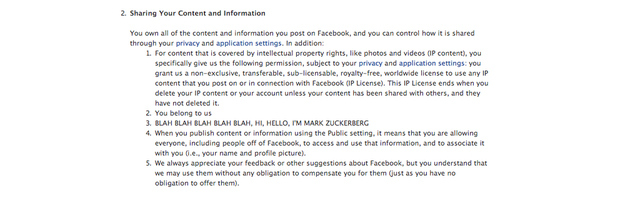
And so these sites have to get your permission — a license — to copy and distribute the things you post. Just to function as advertised, they need your permission to "use" and to "host," to "store" and "reproduce." What they don't necessarily need is the right to "modify" and "create derivative works," or to "publicly perform." That is, unless they need to make money. Which of course they do.

It's a little easier to understand why Facebook needs to license your content for your profile than why Google needs such a broad license for Google Drive, since Google Drive is supposed to a private locker, not a public page. But it doesn't really matter that much. In terms of copyright, they're more similar than they are different.
A terms of service that gives an online company enough leeway to operate will legally give them permission to do a lot of things that most companies know better than to do. Pinterest suddenly selling prints of its users' pinboards would be a terrible PR move and a dumb business plan. But they could probably get away with it if they wanted to. Facebook Beacon was terrifying and stupid (which is really just a deluded way of saying "five years too soon"), but probably wasn't illegal.
Rather than risk a narrower terms of service, companies have started getting clever, even reassuring. When Facebook bought Instagram I worried that its seemingly generous terms of service would get replaced. The first sentence in its "Rights" section reads like it's supposed to be shouted through a bullhorn:
Instagram does NOT claim ANY ownership rights in the text, files, images, photos, video, sounds, musical works, works of authorship, applications, or any other materials (collectively, "Content") that you post on or through the Instagram Services.
But it turns out that it wouldn't matter if Instagram's TOS got replaced with Facebook's. That first sentence is all seduction: Instagram doesn't claim ownership rights because it doesn't need to, and because that would be ridiculous. It's sort of like if Instagram put at the top of its TOS, "Instagram does NOT claim ANY right to hang out in your house and eat your food." Obviously!
"When [companies] say you 'own' something," says Lastowka, "they say you own it but you've given them an unlimited license." The next sentence of Instagram's TOS, the one about licenses, is virtually identical to Facebook's, and enough to make a reasonable person feel like he's giving up the feeling of ownership every time he logs in.
And so we find the disconnect. Do you really own something if another person, or another company, can do whatever they want with it? Does it feel like you still fully own something when a billion-dollar company is making money from it and not paying you a dime?
My brain says no. But my still-active Facebook account says yes.