Supreme Court Asks If It Can Even Consider Case Challenging DOMA

A Harvard Law School professor will argue that the Obama administration’s actions opposing DOMA mean the court can’t hear the appeal.

I know, right? Now tell your friends!
Supreme Court Asks If It Can Even Consider...
Chris Geidner

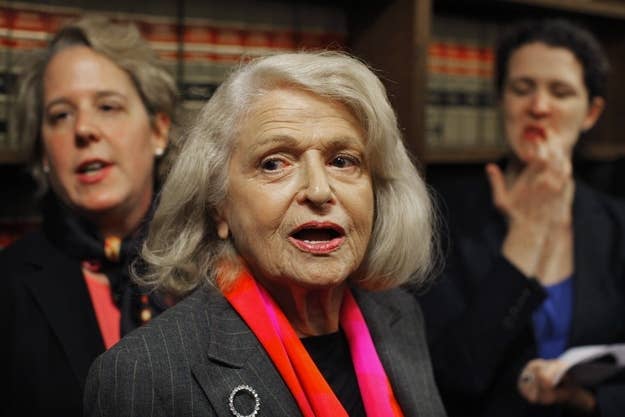
Edith Windsor is challenging the constitutionality of the Defense of Marriage Act.

Image by Eduardo Munoz / Reuters

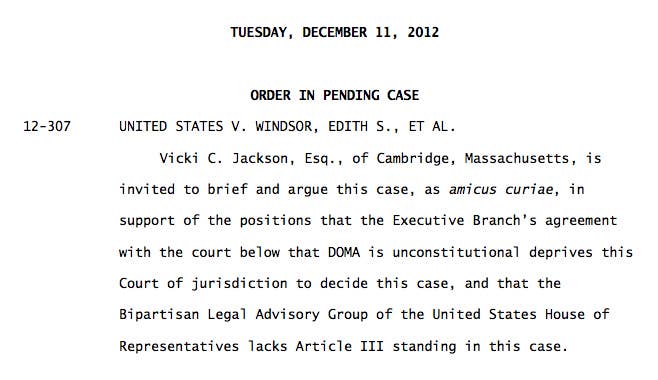
WASHINGTON — The Supreme Court announced Tuesday that it will be hearing arguments from a Harvard Law School professor about whether the court even has the ability to hear a case challenging the Defense of Marriage Act.

Specifically, the court asked Harvard law professor Vicki Jackson to argue that the Department of Justice’s position in earlier proceedings in the case that DOMA is unconstitutional “deprives this Court of jurisdiction” to hear the appeal. Additionally, Jackson is to argue that the House Bipartisan Legal Advisory Group (BLAG), controlled by the House Republican leadership’s majority in the group, does not have standing in the case.

The procedural questions relate to the U.S. Constitution’s limits on the court’s cases to those involving actual “cases” or “controversies.” The court is considering whether the Obama administration’s decision to agree with the plaintiff suing the government that the law is unconstitutional makes this no longer an actual controversy. Likewise, the court is considering whether BLAG — as a part of the legislative branch — has the constitutional ability to present an argument as a party to the case.

The move came days after the court announced it would be hearing the appeal about the federal definition of marriage contained in the 1996 law, at which point it noted that it was considering this jurisdictional question.

Tuesday’s appointment of Jackson, however, takes a dispute that has been taking place on the sidelines of the case up to this point and makes it a central issue in the coming months.

Jackson, the Thurgood Marshall Professor of Constitutional Law at Harvard, is the co-author of the 2008 book, Inside the Supreme Court: The Institution and Its Procedures. She also is the author of an essay, “Gender Equality and the Idea of a Constitution: Entrenchment, Jurisdiction and Interpretation,” contained in a 2009 book about comparative constitutional law.

3. Tuesday’s Supreme Court Order

Check out more articles on BuzzFeed.com!

Facebook Conversations


    4 Responses So Far

    • bandk 5 months ago

      Whatever happens, one thing is sure: neither DOMA nor Prop 8 have the slightest chance to survive next year. They are less than trash!

    • megl   Supreme Court Asks If It Can Even Con...  about 5 months ago
    • LorrieFludd 5 months ago

      I hope that the Prop 8 case doesn’t have standing. If the Supreme Court were to rule on the Prop 8 case and uphold it, it would be a huge setback for LGBT rights. I think it’s slightly too soon to bring the issue to the high court. However, I hope that they do review DOMA. I think that DOMA has a really good change at being overturned.

    • jeffreydanielg   Supreme Court Asks If It Can Even Con...  about 5 months ago
    • WI53212 5 months ago

      There are many thousands of people in bi-national marriages and in marriages from States that sanction same-sex marriage, but now living in States that don’t, whose lives would be subject to even more turmoil than they already are. A ‘no-standing’ decision would be the most terrible outcome for marriage equality and for fairness and justice.

    • ca90046 5 months ago

      Technically the Court is on solid ground with a refusal to hear the DOMA and Prop 8 cases based on a lack of standing. As absurd as it sounds, if the DOJ is not offering any defense in any district, DOMA would fall by the wayside district by district. Prop 8 would also fail and the ruling limited to California.
      For Federal purposes marriages would be portable but couples would have federalized marriages in states that would not recognize marriage.
      The framework of bureaucracy would be boggled by the administrative hurdles the states have in place as couples would have to challenge state’s constitutions until the Supreme Court finally makes a ruling.
      I guess Chief Justice Roberts just does not want to hear Scalia’s homophobic rants from the bench.
      WOW

    Now Buzzing