
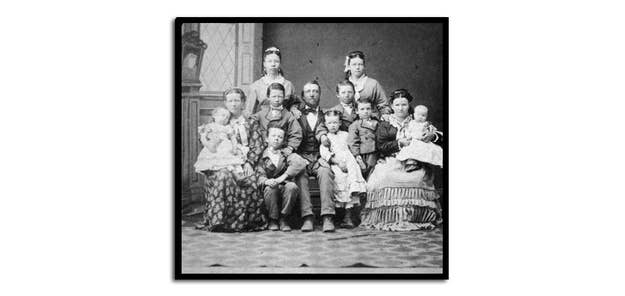
The lawyer for House Republican leaders had to reach all the way back to 1885 today when asked where the “traditional understanding” of marriage could be found in federal case law — referring to a case dealing with polygamy in the Utah territory.
That case, decided about polygamy in Utah before women were guaranteed the right to vote, came only 20 years after the end of the Civil War and more than 80 years before the court would strike down bans on interracial marriage. Today, it was one of the underlying arguments in House Republican leaders’ case that the Supreme Court recognizes a "traditional understanding" of marriage that the Defense of Marriage Act is seeking to uphold.
The Republicans' lawyer, Paul Clement, never used the word "polygamy." But the 1885 case and other government efforts aimed at stopping polygamy came up throughout today's hearing about DOMA's constitutionality.
Clement, who has argued several high-profile conservative causes in the past year, was in court today in New York defending the federal definition of “marriage” and “spouse” contained in DOMA. He is arguing the case for House Republican leaders because President Obama and Attorney General Eric Holder concluded that DOMA is unconstitutional in February 2011 and stopped defending court challenges to the law at that time.
The second federal appeals court to consider the law’s constitutionality, today’s arguments before three judges of the Second Circuit Court of Appeals came even as several cases — including this one — have been presented to the Supreme Court for review. Because the Supreme Court has not acted, however, the appeal in the case of Edith Windsor went forward today.
The arguments were at points similar to arguments heard in April before the First Circuit Court of Appeals in Boston, which determined that the law is unconstitutional. Today's arguments, however, included an admission by Clement that if courts decide that laws targeting gays and lesbians should be viewed skeptically, like those based on race or sex, then it would be more difficult to justify DOMA.
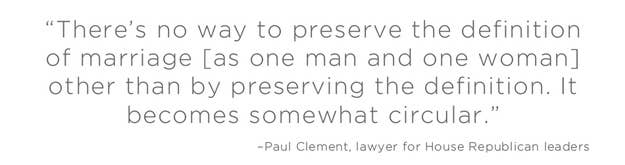
“That said, I’ll try it,” Clement told the judges, noting that "there’s no way to preserve the definition of marriage [as one man and one woman] other than by preserving the definition. It becomes somewhat circular.”
The question of the level of scrutiny to be applied to classifications, like DOMA, that group people based on their sexual orientation was the major issue debated today. The level of scrutiny is the way that courts enforce the Constitution’s guarantee of equal protection of the laws. Laws that classify based on race are subjected to strict scrutiny, which means the government needs to show that the law in question meets a compelling interest. For laws that classify based on sex, the court subjects them to intermediate scrutiny and the government must show an important governmental interest is advanced by the law. If the classification isn’t within one of those areas of heightened scrutiny, then the government just needs to show there is a legitimate, or rational, basis for the law.
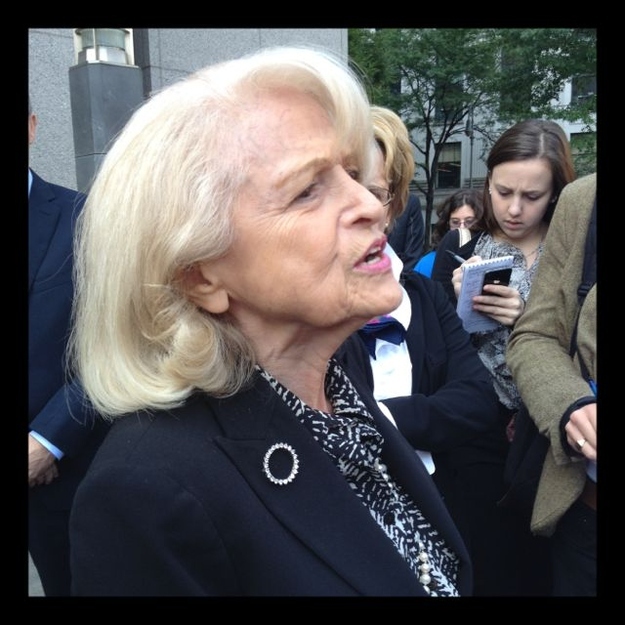
The lawyer for Windsor, a widow suing to recoup a $350,000 federal estate tax bill she was forced to pay because DOMA prevented her marriage to a woman from being recognized by the federal government, noted Clement’s comments when she presented her case to the judges. Saying that the House Republicans’ lawyer hadn’t explained how the law could be upheld under heightened scrutiny when the case was before a trial judge, Roberta Kaplan told the judges, “He tried to do it today. I don’t think it works.”
In order to decide the level of scrutiny to apply, courts look to factors like whether the trait at issue is unchangeable and unrelated to a person’s ability to perform or contribute to society and whether the group in question has a level of political powerlessness and a history of discrimination. House Republicans leaders argue that those factors should lead courts to conclude that only rational basis applies.
Clement argued that gays and lesbians have a proven ability to get the attention of legislators, noting that more than 130 lawmakers filed a brief with the court supporting Windsor’s challenge. Because of that, he said, “It’s not clear why they need the courts to intervene.” He added that gays and lesbians, unlike black people and women, have never faced “a structural impediment” preventing them from voting.
Stuart Delery, the acting assistant attorney general, is in the unusual position of representing the federal government and arguing that a federal law that had been defended by the federal government since its passage in 1996 until 2011 actually is unconstitutional. When the government changed its in position in 2011, it did so because, based on Windsor’s case, Obama and Holder concluded that sexual orientation-based classifications like DOMA should be subjected to some form of heightened scrutiny.
As such, Delery joined Kaplan in countering Clement’s claims, noting the existence of sodomy laws until the Supreme Court’s 2003 decision striking them down as unconstitutional. Calling those laws “an invitation to public and private discrimination” against gay, lesbian and bisexual people, Delery argued that sexual orientation has “no bearing on an individual” person’s ability to contribute to society.
Delery, however, faced some pushback from Chief Judge Dennis Jacobs, a George H.W. Bush appointee to the bench who noted the changed position of the administration on the law’s constitutionality, and saying, “Your presence here is an argument against your argument.”
Although Delery acknowledged the importance of the administration’s changed position, he countered that the rights of gay and lesbian people often lose when they are subjected to a vote. Kaplan, for her part, noted that more than 30 states have either statutory or constitutional bans on same-sex couples marrying.
If the court does side with Clement and conclude that rational basis applies to DOMA, then Kaplan — a partner at Paul, Weiss, Rifkind, Wharton & Garrison LLP, which is working with the American Civil Liberties Union on Windsor’s case — argued to the court that DOMA is still unconstitutional because the reasons advanced by the House Republican leaders do not provide even a rational basis for upholding the law. Such a decision would echo the decision of the First Circuit Court of Appeals earlier this year when it affirmed a lower court’s ruling that DOMA is unconstitutional.
That decision utilized a more searching form of rational basis scrutiny — rational basis-plus, some call it — because of the nature of DOMA’s federal intrusion into the traditional state role of defining who can and cannot marry. In response to a question about the decision by Judge Christopher Droney, an Obama appointee, Clement said, "There’s no support" for the "plus" coming from such claimed federalism concerns. "Three levels of scrutiny is enough."
Clement also argued that in addition to DOMA's definition of marriage being an ordinary attempt to preserve federal resources — "line-drawing," House Republican leaders argue — Congress has a rational basis for choosing uniformity in national policy in this changing area over deference to states’ decisions on the issue.
Kaplan countered that saving money is not, without any other basis, a reason for upholding DOMA. As for the uniformity argument, echoing the First Circuit’s decision, Kaplan said that “the uniformity was already here,” referring to the deference to states’ definitions of marriage.
In his closing rebuttal, Clement told the court that Congress has overridden states’ determinations about marriage. He gave two examples: fraud statutes and conditions placed on statehood aimed at stopping polygamy.
More than 30 years before the U.S. Constitution would be amended to prohibit voting discrimination based on sex, the Supreme Court upheld the constitutionality of a law that required those in the Utah territory to take an oath that included a statement that the male was violating bigamy or polygamy prohibitions.
The case, which cited the infamous Dred Scott Supreme Court decision declaring that slaves were not citizens under the U.S. Constitution as evidence of governmental powers in the territories, was mentioned by Clement. It’s the case, he told Judge Chester Straub, a Clinton appointee to the bench, where the Supreme Court referenced the "traditional understanding" of marriage.
The 1885 case takes a hard line on the role of marriage in the post-Civil War nation, in reference to the practice of polygamy in the Utah territory.
The court wrote that "no legislation can be supposed more wholesome and necessary in the founding of a free, self-governing commonwealth … than that which seeks to establish it on the basis of the idea of the family [is] consisting in and springing from the union for life of one man and one woman in the holy estate of matrimony."
That definition of marriage, the court wrote in 1885, is "the sure foundation of all that is stable and noble in our civilization; the best guaranty of that reverent morality which is the source of all beneficent progress in social and political improvement."