
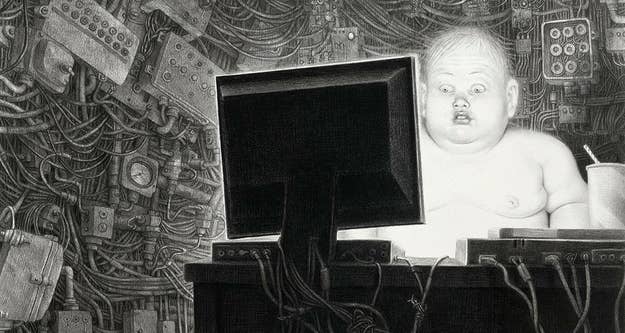
Tell me if this sounds familiar:
Imagine, if you can, a small room, hexagonal in shape, like the cell of a bee. It is lighted neither by window nor by lamp, yet it is filled with a soft radiance. There are no apertures for ventilation, yet the air is fresh. There are no musical instruments, and yet, at the moment that my meditation opens, this room is throbbing with melodious sounds. An armchair is in the centre, by its side a reading-desk-that is all the furniture. And in the armchair there sits a swaddled lump of flesh-a woman, about five feet high, with a face as white as a fungus. It is to her that the little room belongs.
This is from E.M. Forster's The Machine Stops, a gut-wrenchingly lucid prediction of the Internet age. (Throw it in your Instapaper queue, it's fantastic.)
Now, consider tech's Big Ideas in 2012:
-Augmented reality
-Constant, full connectivity
-Big/infinite data
-Engineered health
-The quantified self
-The complete redefinition of privacy
Taken together, don't they sound more than a little foreboding? Or at least worthy of pause? The tech world's headlines tell a story of a people who aren't just becoming more like the fungus-faced woman in her little tiny room, but aspiring to be like her. So many of the tech industry's goals reek of dystopia, of loss of humanity. Our most powerful companies are working toward our grimmest fantasies. Dystopias are for avoiding, not for chasing.
***
Google's Project Glass was initially received as a joke, and rightly so. There is no chance — none, zero — that the first version will be good. Google doesn't release completed products. They do, however, release completed ideas. Google Search is a product-in-progress, but it's a clear expression of the ideal of instant, full recall. Google Books, Scholar and Patents are miles from completion but the core concept — that there should be a place to house and serve up the entirely of world knowledge — is there. Android, clunky as it can be, is an earnest step in the direction of always-on connectivity, and Project Glass is by-the-books augmented reality, straight out of sci-fi. Just, not the nice kind.

Read the gadget blogs long enough and you'll start to pick up on a pattern: Whenever possible, writers invoke Minority Report. It started, I think, with the Microsoft Surface multitouch table, or maybe the iPhone, which drew comparisons to the translucent touch interface used in Tom Cruise's pre-crime lab. It's served as shorthand for facial recognition tech and contextual advertising, for the whole of neuroscience, and for pretty much anything that seems futurey. It's handy! Everyone's seen it and, for a movie based on a short story, is extremely concept-dense. It's a greatest hits collection of sci-fi ideas.
Here's the thing that we seem to be forgetting: these are dystopian concepts. Just because they've been written into the fictional future a few times doesn't mean they're inevitable, and even if it did, inevitability doesn't equate with goodness. The man who wrote Minority Report, Philip K Dick, had a unique talent for identifying the nightmares of the near future. The tech industry has a similar knack for realizing them.
Our current Big Ideas appeared in fiction well before the tech industry could even consider turning them into products. When Asimov and Dick and Clarke and even Forster first engaged with them, their formidable minds race straight into darkness. They wrote cautionary stories about endpoints: the day when reality isn't discernable from the digital, when the police can arrest you before you've committed a crime, when you're so jaded by information overload that you can't think, the day when machines surpass humans. This is still what good sci-fi artists do: they foster a feeling of wonder, tempered by dread.
Now, as the tech industry fumbles toward realizing these ideas, nobody's minds are racing anywhere except down slippery slopes. The redefinition of privacy should be a mitigated side effect of something we want, not a goal unto itself. It's very easy to careen down slippery slopes! That's the whole point.

Google's Project Glass video is the tech demo equivalent of a series of gags in Scary Movie ; it works because we recognize it, not because it's good. The force that animates the tech industry, after money, is the pursuit of recognition.
It's trickled down to us, the users, too: I have to wonder how many of the thousands of people who donated a total of over $3 million to the Pebble smart watch actually stopped to think, is this a good idea, or just something I've read about and seen in movies? Was the crowd at Coachella happy to see Tupac this weekend, or were they just nodding in recognition: yes, I remember this from that movie with Al Pacino, what was it called? The tech world is chasing the retro-future; the future of the past, the future that we were supposed to fear and guard against.
Is it too much to ask that our tech giants at least try to invent a new one? And for us, the tech-using public, not to indulge them when they don't? The best sci-fi gives us hindsight before we've really earned it. Let's use that for all it's worth.